


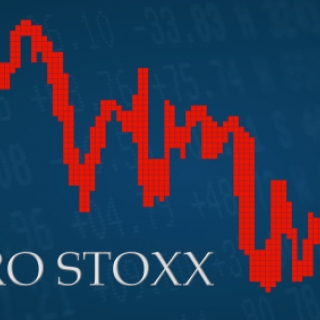
European stock markets closed sharply lower on Friday, with investors still reeling from the scale of U.S. tariffs announced this week.
The regional Stoxx 600 index closed down 5%, marking its worst weekly loss of the year, down 8.3% from the previous week.
Banks fell 8.5% after a 5.53% drop on Thursday. The sector, once seen as vulnerable to slowing growth or recession, is now seen as a much stronger possibility for both the U.S. and global economies. Banks are also "one of the slowest assets to come forward in assessing global macro issues," Bank of America strategists said Friday. China, which has been slapped with 54% total tariffs by the U.S., said Friday it would retaliate with its own 34% tariffs on all U.S. imports starting April 10.
In response, US President Donald Trump said on Truth Social: "CHINA IS WRONG, THEY PANIC - THE ONE THING THEY CAN'T DO!"
The Stoxx 600 closed 2.57% lower on Thursday, as the world digested Trump's steep tariffs on more than 180 countries, raising fears of a global trade war and a US recession to boiling point.
Among the hardest-hit sectors on Thursday was retail, with the Stoxx Luxury 10 index falling 5.2% in its worst session in almost four years. Shares in shipping giants Maersk and Hapag-Lloyd, a gauge of global economic health, both fell more than 9%.
The broad tariffs are particularly harsh on export-dependent developing countries in Asia that make clothing and other consumer goods for the world. Trump's 25% tariffs on imported vehicles to the US also came into effect this week, following his tariffs on steel and aluminium.
The euro rallied strongly against the U.S. dollar after the news, hitting a six-month high, though it traded flat on Friday.
Economists are still struggling to assess the scale of the impact, which will depend on how long the tariffs remain in place and how other countries retaliate.
The European Union said Thursday it would prepare retaliatory measures against the U.S. if negotiations fail.
French President Emmanuel Macron urged French companies to halt planned investments in the U.S., and Germany's acting economy minister Robert Habeck said Trump would "buckle under pressure" if Europe is unified in its response. (Newsmaker23)
Source: CNBC
Tested EN...
Asian stock markets weakened for the second consecutive day, indicating that the initial rally that had been "speedy" at the start of the year is starting to lose steam. At the same time, US governmen...
US stocks were mixed on Wednesday as investors weighed uneven economic data against expectations for eventual Federal Reserve easing, with the S&P 500 easing 0.2% and the Dow Jones sliding 0.8% fr...
European stocks were in mixed territory on Wednesday morning, as regional market jitters grow over U.S. President Donald Trump's threat to annex Greenland. The pan-European Stoxx 600 was little chang...
Asian stock markets weakened slightly on Wednesday after posting their best start to the year in history. The decline was driven by a decline in Japanese stocks amid escalating tensions with China. Th...
Oil prices stabilized on Thursday (February 12th), as the market reassigned a risk premium to US-Iran tensions despite US inventory data showing swelling domestic supplies. This movement confirms one thing: geopolitical headlines are still more...
Gold prices weakened slightly on Thursday (February 12th), as more solid US employment data reduced market confidence in an imminent Federal Reserve interest rate cut. The strong employment data prompted market participants to shift expectations of...
The Hang Seng Index reversed its downward trend in Hong Kong on Thursday (February 12th), weakening by around 0.9% to around 27,000 after a strong session earlier. This decline halted the momentum of the short term rally, as investors began to...